Why Choose Python?
Python is the most popular and beginner-friendly programming language in the world today. Whether you are a complete beginner writing your very first line of code, a college student preparing for tech interviews, or an engineer building modern Artificial Intelligence applications, Python is always the number one recommendation.
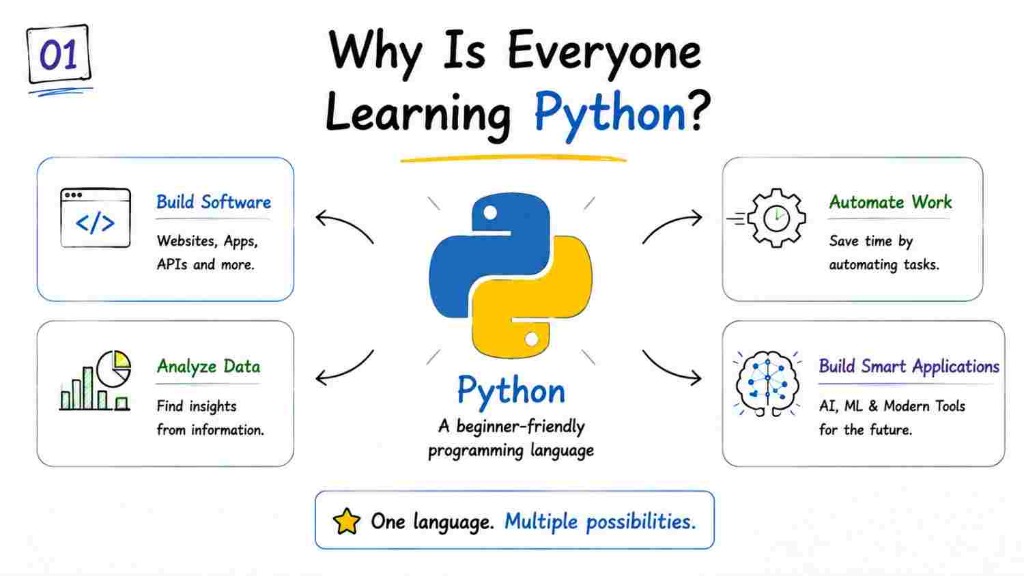
From creating full-stack web applications and automating repetitive daily tasks to crunching big data and training AI neural networks, Python powers every modern tech domain.
1. What Exactly Is Python?
At its core, Python is a high-level programming language designed to make communication between humans and computers effortless:
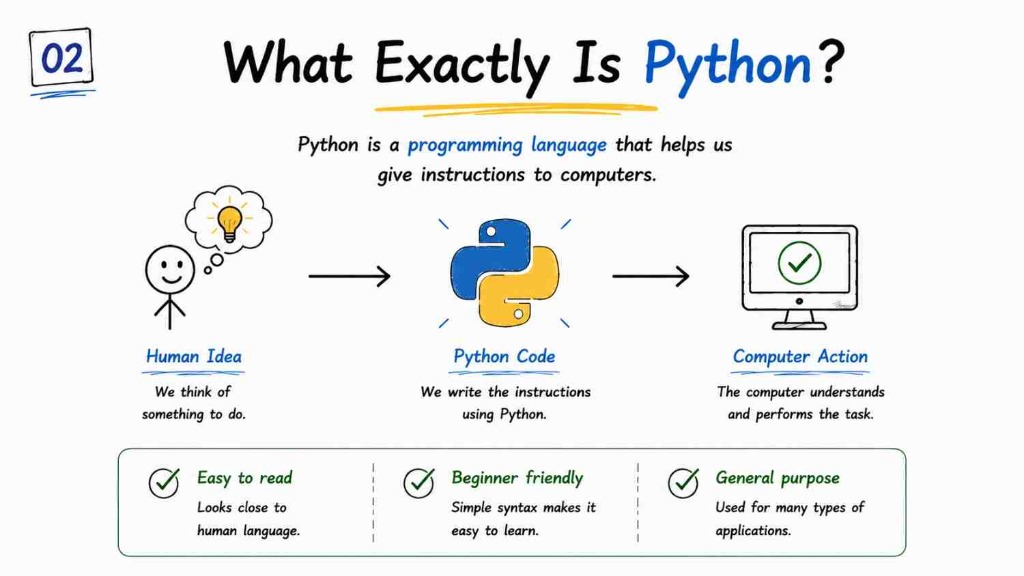
The 3-Step Execution Flow:
- Human Idea: You think of a problem to solve or a task you want the computer to perform.
- Python Code: You write simple, clear instructions using Python syntax.
- Computer Action: The computer instantly understands your instructions and executes the task accurately.
Easy to Read
Python code reads almost like everyday English, making it clean and easy to follow.
Beginner Friendly
Simple syntax eliminates complex boilerplate symbols and reduces beginner anxiety.
General Purpose
A versatile language suitable for web apps, data analysis, automation, and AI.
2. Why Do Beginners Start with Python?
Many traditional programming languages require complex symbols, strict curly brackets {}, and mandatory semicolons ; at the end of every line. If you miss even a single semicolon, your entire program crashes with frustrating errors!
Python completely redesigns this experience. It is intentionally designed to be clean, intuitive, and welcoming to new learners:
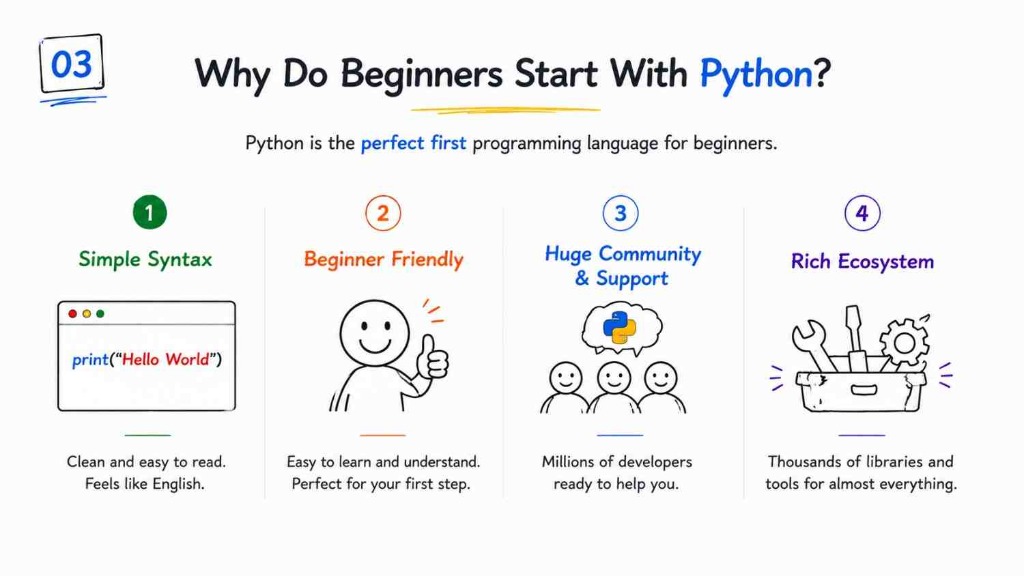
The 4 Core Pillars of Python:
-
Simple Syntax: Writing Python feels like writing plain English. Showing a message on screen requires just one clean line without any complicated setup:
# Showing a message on the screen takes just one line:print("Welcome to Python!") # Output: Welcome to Python! -
Beginner Friendly: Because Python uses clean indentation (spaces) instead of curly brackets, you can focus on logical thinking and problem-solving rather than worrying about missing punctuation.
-
Huge Global Community & Support: Millions of developers worldwide use Python daily. Whenever you encounter a bug or have a question, thousands of tutorials, community forums, and solutions are available instantly.
-
Rich Ecosystem & Libraries: Python has over 500,000+ pre-built packages (libraries). Tasks that take 50 lines of code in other languages can often be completed in just 3 to 4 lines in Python.
3. Where Is Python Used in the Real World?
Python is not just an academic learning tool: it is an industrial superpower used across every major tech field:
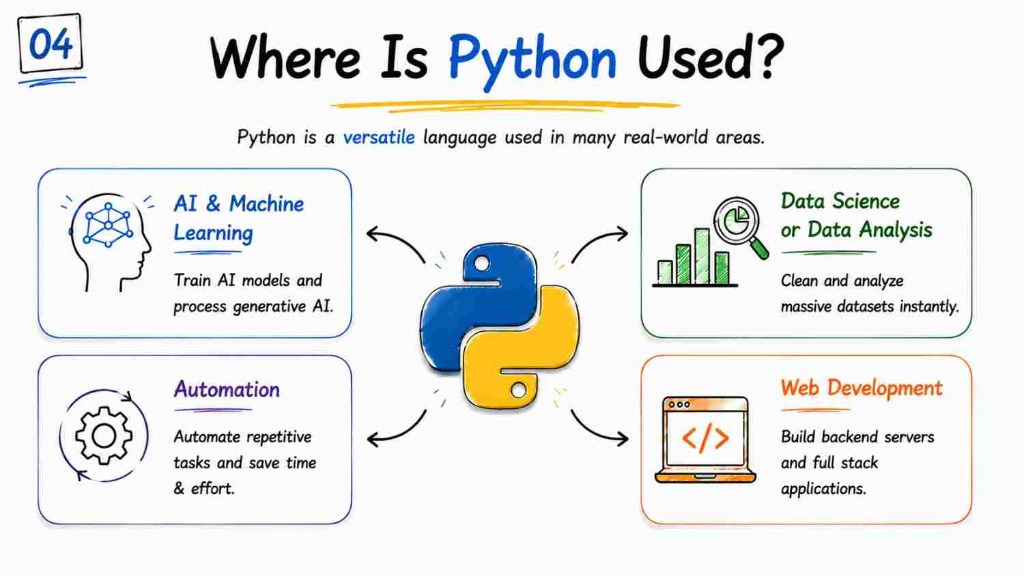
4 Major Application Domains:
- AI & Machine Learning: Training neural networks, generative AI models, chatbots, and computer vision systems using frameworks like PyTorch, TensorFlow, and Hugging Face.
- Data Science & Data Analysis: Cleaning massive datasets, uncovering business trends, and building visual dashboards using Pandas, NumPy, and Matplotlib.
- Automation & Scripting: Automating repetitive manual tasks, such as organizing thousands of files, scraping website data, and generating automated Excel reports in seconds.
- Web Development: Building secure, scalable backend servers and REST APIs using modern frameworks like FastAPI, Django, and Flask.
Top Tech Giants Powered by Python
- Google: Uses Python for its core search engine algorithms, YouTube video infrastructure, and AI research.
- Netflix: Uses Python's data analysis tools to predict viewer preferences and recommend your next favorite show.
- Spotify: Powers its high-speed backend streaming APIs and personalized music recommendation engines.
- Instagram: Runs on the world's largest Django (Python) backend deployment, serving billions of posts daily.
- NASA: Uses Python to process satellite imagery, perform scientific calculations, and navigate deep-space missions.
4. Python Is a Foundation, Not the Final Destination
A critical truth every beginner must understand before writing code: Python alone is not enough to land a high-paying software job.
Many learners mistakenly believe: "If I just learn Python syntax (loops, if-else, functions), companies will immediately hire me."
In reality, Python is just the universal coding engine (the foundation tool). Companies don't hire developers just to write generic for loops: they hire you to solve specific domain problems (like building web servers, analyzing financial numbers, or automating daily tasks).
To turn Python into a high-paying career, you must apply the "Python + Domain Knowledge" formula:
Python (Coding Foundation) + Domain Knowledge (Specialized Tools) = High-Paying Career Opportunities
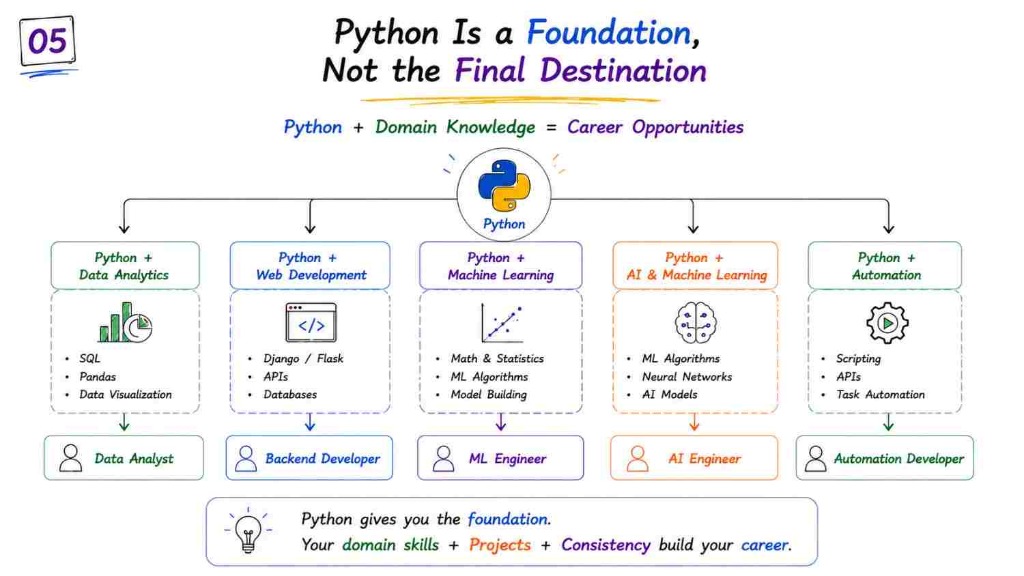
How "Python + Domain Skills" Turn into Careers:
When you combine your Python foundation with a specific domain, here is the exact job role you unlock:
Python + Data Analytics = Data Analyst
- The Domain You Add: Extracting insights from business numbers using
SQL,Pandas, andPower BI / Tableau. - What You Do: Clean messy company data, analyze sales or user trends, and build visual dashboards so leaders can make smart decisions.
- Real-World Example: Analyzing food orders on Swiggy to discover which restaurant dishes sell best on weekend nights.
Python + Web Dev = Backend Developer
- The Domain You Add: Building server backbones with
DjangoorFastAPI,REST APIs, andDatabases (PostgreSQL / SQLite). - What You Do: Build the invisible engine behind websites and mobile apps (handling user logins, database storage, and secure payment processing).
- Real-World Example: Building the ticket booking and payment verification engine for BookMyShow or Netflix.
Python + Machine Learning = ML Engineer
- The Domain You Add: Teaching computers to learn patterns using
Math & Statistics,Scikit-Learn, andPredictive Modeling. - What You Do: Train mathematical models on past data so computers can make accurate predictions automatically.
- Real-World Example: Building a banking system that detects credit card fraud in milliseconds or predicts loan default risks.
Python + AI & Deep Learning = AI Engineer
- The Domain You Add: Building intelligent cognitive apps using
Neural Networks,PyTorch,LLMs & Prompt Engineering. - What You Do: Create cutting-edge artificial intelligence systems (including ChatGPT-style chatbots, AI coding assistants, and voice agents).
- Real-World Example: Building custom customer support AI agents, real-time voice translation bots, and medical scan image analyzers.
Python + Task Automation = Automation Developer
- The Domain You Add: Eliminating repetitive computer chores using
Scripting,Web Scraping (Selenium / BeautifulSoup), andAPIs. - What You Do: Write automated scripts that save companies hundreds of hours of manual labor every week.
- Real-World Example: A script that automatically logs into 20 supplier portals every midnight, downloads PDF invoices, extracts totals into Excel, and emails a morning summary report.
- Step 1 (This Course): Master pure Python fundamentals, logic, and problem-solving (Part 1, Part 2 & Part 3). This gives you your unbreakable programming foundation.
- Step 2 (Specialization): Pick one domain from the list above that excites you the most, master its specialized tools, and build 2-3 portfolio projects to land your dream job!
5. Python Demand & Popularity (2020 - 2025)
Python's adoption continues to break global records year after year according to premier industry benchmarks:
1. TIOBE Index (Global Search Engine Interest)
The TIOBE Index tracks global developer activity, search volumes, and engineering interest across all programming languages:
- 2020 & 2021: Awarded "Programming Language of the Year" for unprecedented global growth.
- 2024: Crowned "Programming Language of the Year" once again after a record +9.3% surge.
- 2025: Achieved an all-time record rating of 26.98% (July 2025 Report), the highest single score ever recorded in the history of the index.
2. Stack Overflow Developer Survey
Surveying over 90,000 professional software engineers worldwide:
- #1 Most Wanted Language: Consistently ranked as the language non-Python developers most desire to learn.
- Top Backend & AI Language: Solidified its place as the industry standard for backend engineering, data science, and AI pipelines.
(Sources: TIOBE Index, Stack Overflow Developer Survey)
Quick Summary
- What is Python? A high-level, human-friendly language that acts as a bridge between your logical thoughts and computer execution.
- Why Choose Python? Clean English-like syntax, zero syntax anxiety, rapid development speed, and a massive global support community.
- Where is it Used? Web Development, Data Analytics, Machine Learning & AI, and Everyday Task Automation.
- The Career Unlock Formula:
Python (Coding Foundation)+Domain Knowledge (Specialized Tools)= High-paying software careers. - Global Popularity: Consistently ranked the world's #1 most popular language across the TIOBE Index and Stack Overflow Developer Surveys.
What's Next?
Now that you understand why Python is the ideal programming language, let's get your computer set up and write your very first Python program in Module 1: Getting Started!